Dantrolene-induced ER stress alters sleep in Drosophila melanogaster
(1) The Hockaday School, (2) Division of Sleep Medicine, Perelman School of Medicine at the University of Pennsylavania
https://doi.org/10.59720/24-072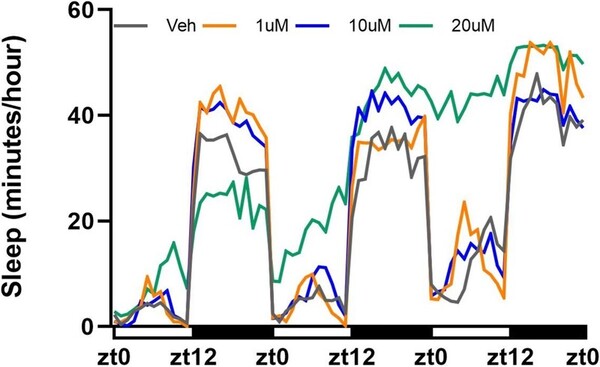
Sleep is a well-conserved behavior that, despite our limited understanding of it, has been shown to provide a number of neurological and neuroprotective benefits such as immune function and neurogenesis. Sleep-deprived animals have been found to exhibit higher levels of cellular stress, especially endoplasmic reticulum (ER) stress. In this work, we aimed to determine if an inverse relationship occurs between sleep and ER stress. We hypothesized that an increase in ER stress would cause a disruption in sleep patterns, specifically causing short intermittent sleep rather than continuous sleep. To test this, we introduced an ER-stress inducing drug, dantrolene, to one-week-old White Canton-S 10 (WCS10) Drosophila melanogaster through their diet. We then measured their sleep using video recording for three full days to determine sleep duration, the number of sleep bouts, and sleep bout length during the day and at night. After three days, we measured the concentration of ER stress-specific markers, binding immunoglobulin protein (BiP) and phosphorylated eukaryotic translation initiation factor 2 alpha (p-eIF2α), to determine the amount of ER stress. Flies that ingested dantrolene had more sleep especially at night with an increase in the sleep bout number during the day. The increase in sleep correlated with the increase in BiP and p-eIF2α in dantrolene-fed flies. Our findings provide new insight into the connections and relationships of sleep with the body’s functions, suggesting a correlation between ER stress levels and sleep.
This article has been tagged with: