In silico design of an epitope-based vaccine for Rocio virus using phage display and E. coli expression system
(1) Thomas Jefferson High School for Science and Technology, (2) Department of Biology, Catholic University of America
https://doi.org/10.59720/24-279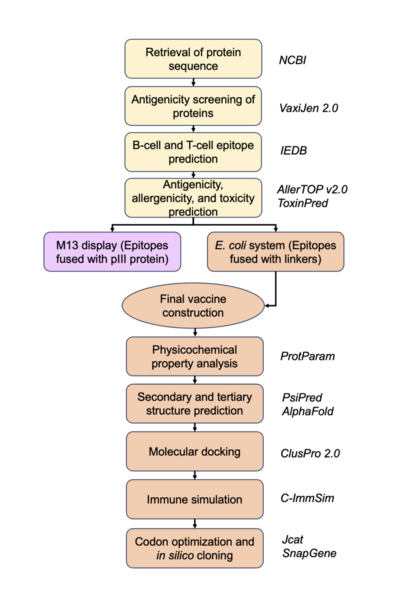
The Rocio virus, a member of the Flaviviridae family transmitted by Culex mosquitoes, causes headaches, fever, confusion, and fatal neurological symptoms. Currently, there is no approved vaccine available for the virus. Traditional Flaviviridae vaccine platforms rely heavily on live attenuated or inactivated viruses, which have significant limitations regarding safety. Here, we hypothesized that computational tools could be used to develop an epitope-based vaccine integrating M13 bacteriophage by generating epitopes that elicit a strong immune response against the Rocio virus. Using bioinformatics tools, we analyzed the proteome of the Rocio virus and selected 30 key B and T cell epitopes based on their antigenicity, allergenicity, and toxicity scores. We demonstrated both a phage-based epitope display and fusion epitope production using a bacterial expression system. In the phage-based delivery mechanism, a minor coat protein (pIII) of M13 bacteriophage was fused with the epitopes. Conversely, in the E. coli expression system, we designed the vaccine candidate by joining predicted epitopes with linkers to create a final antigenic product. Through molecular docking, we identified that the vaccine candidate binds effectively with antigen receptors and induces a robust immune response with an in silico immune simulation. Overall, this computational approach allows for the rapid generation of epitopes and demonstrates a novel framework combining bacteriophage display and bacterial expression. Nevertheless, further in vitro and in vivo experiments are essential to evaluate the candidate’s safety, efficacy, and ability to neutralize the virus.
This article has been tagged with: