A low-cost, Arduino-based system for real-time abiotic monitoring of a local watershed
(1) Montgomery Blair High School, (2) Takoma Park Middle School
https://doi.org/10.59720/25-049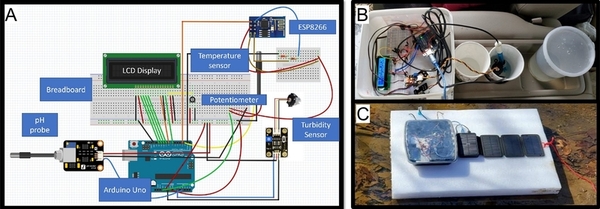
The Chesapeake Bay faces serious challenges, like pollution, from human activity. However, local data on its tributaries, like the Little Paint Branch Stream in Montgomery County, Maryland, are often outdated or incomplete. For example, existing data for Little Paint Branch is limited to biotic indicators (Index of Biotic Integrity), with the most recent data collected in 2016. Including recent, continuous abiotic measurements would improve our understanding of water quality changes on daily to seasonal timescales. To address this gap, we assessed the Little Paint Branch watershed’s condition in 2021 using abiotic measurements and examined how water quality varies over time. We hypothesized that the watershed would be in poor condition due to local construction and deforestation and that water quality shows daily and seasonal variation. To test this, a solar-powered, field-deployable Arduino-based prototype was built that measured turbidity, temperature, and pH four times daily in summer and winter, with three replicates per time point. The device featured internet connectivity for real-time monitoring and rapid response. Contrary to our hypothesis, abiotic data showed the watershed was in generally good condition. Our results showed that water temperature remained stable after 2 p.m. and closely followed air temperature; turbidity peaked at 2 p.m. on weekends and was higher on weekdays in winter, possibly due to runoff or human activity; and pH rose throughout the day, especially on weekends, which may affect aquatic life locally and downstream. This low-cost system shows how accessible technology can allow residents to monitor their environment, increase awareness, and preserve watersheds.
This article has been tagged with: