Comparative study on three machine learning models in novel autonomous drone-based detection of invasive plant Brassica nigra
(1) Basis Independent Silicon Valley, (2) Basis Independent Fremont, (3) Santa Clara High School, (4) Los Altos High School, (5) Washington High School, (6) Computer Science and Engineering Department, ASDRP
https://doi.org/10.59720/25-115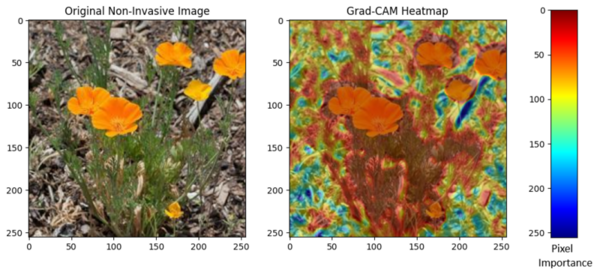
Invasive weeds cost farmers in the USA $33 billion a year to manage. Brassica nigra is an invasive annual herb which increases wildfire risk and produces chemicals that prevent the germination of native plants. We propose a solution to automate the detection of invasive plant species by creating a machine learning model capable of identifying the presence of Brassica nigra from autonomous drone footage. We tested three different machine learning models for the detection of the invasive plant: Convolutional Neural Network (CNN), Stochastic Gradient Descent Classifier (SGDC), and eXtreme Gradient Boosting (XGBoost). We hypothesized that for the detection of invasive plant species from aerial autonomous drone images, a CNN model would outperform SGDC and XGBoost because of its ability to extract spatial features to find complex visual patterns. Additionally, we hypothesized that SGDC would perform better than XGBoost, as our data is linearly separable and SGDC has the ability to do limited feature extraction. Results analyzed through heat maps of each model indicate that there is a statistically significant difference between the ability of the three models to find important features with the ANOVA test (p=9.2e-16). We can conclude that CNNs are the most suitable model for detecting invasive plants from drone footage due to its superior feature extraction abilities.
This article has been tagged with: