Influence of polygon side number on laminar vortex shedding frequency and variability
(1) Eton College, (2) Imperial College London
https://doi.org/10.59720/25-121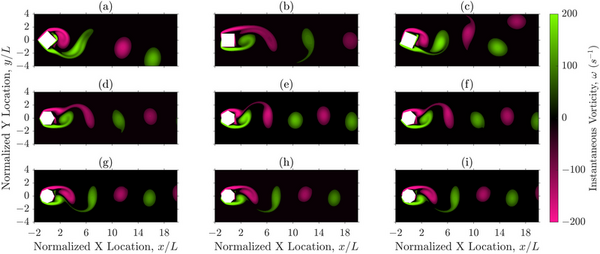
The geometry of polygonal bodies influences unsteady aerodynamic forces exerted from vortex shedding. Prior research has shown sensitivity of a polygon’s shedding frequency to the number of sides and rotational position; however, only a narrow region of Reynolds numbers have been tested, meaning that shedding behavior within different fluidic regimes are yet to be explored. We investigated these shedding characteristics at Reynolds number of 200, focusing on frequency variation and separation behavior. We hypothesized that as the number of sides of the polygon increases, variation in the shedding frequency would decrease due to a reduced variation in the separation point over the polygon. We created a computational fluid dynamics solver to test nine test cases with varying side numbers and angular positions to test this hypothesis. Our results support this hypothesis: we observed an 83% decrease in the range of separation point and a 90% decrease in the standard deviation of shedding frequency comparing octagonal to square polygons. Furthermore, we suggest a new definition for polygonal rotational position that differs from convention, instead defined by the top facing geometry based on the grouping of maximum and minimum shedding frequencies being reversed for the hexagonal case compared to the square and octagonal cases. Results from this work show that designers must consider the variation of vortex shedding frequency for low-sided polygons to reduce the range of frequencies that structures must tolerate, for example, in oil pipelines subjected to ocean currents and large skyscrapers immersed in the wind.
This article has been tagged with: