Using machine learning to detect outliers of red clump stars
(1) Clements High School,, (2) Westlake High School, (3) The University of Texas at Austin
https://doi.org/10.59720/25-144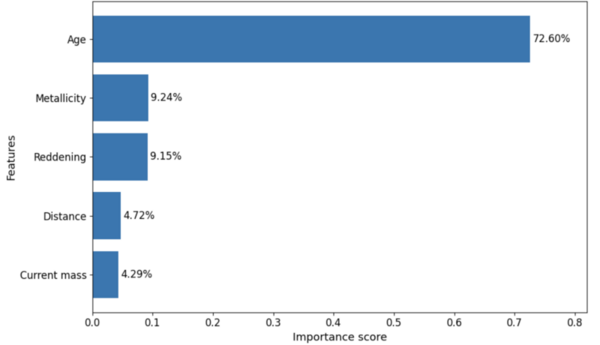
Red clump stars (RCs) are a subset of red giants with relatively constant luminosities, a unique property that allows astronomers to use them as distance indicators in astrophysical research. Accurate distance measurements help astronomers reduce errors in mapping the Galactic Bar, minimizing parallax errors and depths of the Small Magellanic Galaxy. While literature regarding RCs suggests they exhibit constant luminosity, recent observations suggest luminosity variability that is remarkably correlated with age and metallicity of RCs. This uncertainty makes it crucial to identify the outlier group of RCs and determine which stellar properties are most associated with this change in luminosity. We hypothesized that age would be more strongly associated with luminosity variability than metallicity. We used two machine learning models, Extreme Gradient Boosting (XGB) and Isolation Forest (IF), to evaluate feature importance and identify outliers, respectively. The XGB model showed that age had the highest feature importance (72.6%) in predicting luminosity variability, whereas metallicity had a substantially lower feature importance (9.24%). The IF model successfully identified RCs with unusual luminosity or age values as outliers and detected 74.89% of artificially added outliers. Our findings demonstrate that machine learning successfully detected variability in luminosity, which aligned with our hypothesis. Our results will help astronomers understand the influence of stellar parameters on luminosity variability while accurately classifying variability in RCs luminosity to reduce computational inaccuracies in distance estimates.
This article has been tagged with: