Evaluating the filtration efficiency and water quality impact of Corbicula javanicus
(1) The Pingry School, (2) Integrated Coastal Sciences PhD Program, East Carolina University
https://doi.org/10.59720/25-170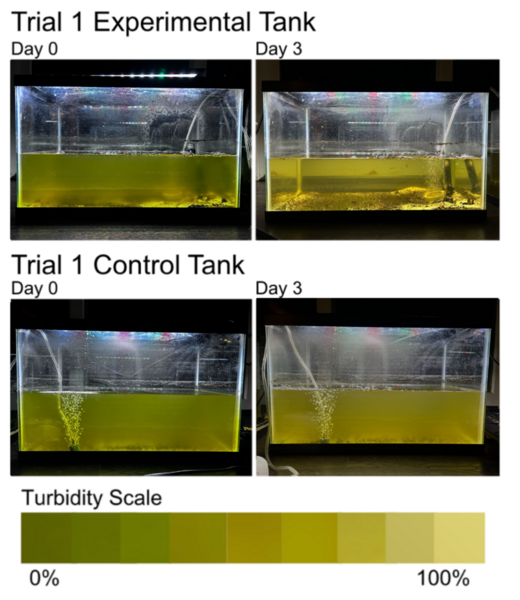
Freshwater ecosystems are vital to both ecological health and human well-being, yet they face significant degradation due to water contamination and loss of biodiversity. Bivalves, a class of aquatic mollusks with a hinged pair of shells, have been found to feed on plant detritus, algae, and other particles, making them a significant contributor to natural water filtration. Their feeding behavior not only removes suspended particles but can also help control algal blooms in nutrient-rich waters. In this study, we investigated the water filtration capabilities of Corbicula javanicus, a freshwater bivalve, to assess its potential in improving water quality. We hypothesized that C. javanicus would improve water clarity in nutrient-rich freshwater environments. To test this, we introduced juvenile clams to experimental tanks containing pond water with high levels of algae, while control tanks remained clam-free. Over a three-day period, we measured water clarity and pH levels. The results demonstrated that C. javanicus improved water clarity, increasing from 25% to 90% in one trial, whereas control tanks remained stagnant. Each clam filtered approximately 0.33 gallons of water per day, based on visual clarity changes assessed in this experiment. These findings align with prior research on filter-feeding organisms and highlight the potential of bivalves in not only saltwater ecosystems, but freshwater environments as well. The use of freshwater bivalves such as C. javanicus offers a promising, sustainable solution for enhancing water quality, benefiting both ecological stability and human communities dependent on these resources.
This article has been tagged with: