A model for angle evolution in conical piles formed using the fixed funnel method
(1) The Gregory School, (2) It’s A Learning Curve LLC
* These authors made equal contributions
https://doi.org/10.59720/25-220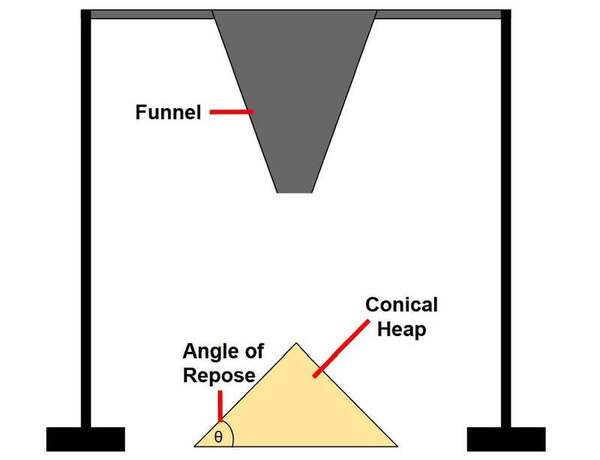
Granular materials such as sand, soils, and industrial powders naturally accumulate into conical piles when poured onto a surface. A key property of these piles is the angle of repose, the maximum stable slope that a granular material can maintain, which is widely used to quantify flowability and predict the behavior of granular systems in applications ranging from soil stability and powder handling to additive manufacturing. Although the angle of repose has been studied extensively, little is known about how pile angles evolve during formation before reaching this stable maximum. We hypothesized that pile angles would increase nonlinearly and approach their final value asymptotically as material accumulated. To test this idea, we used the fixed-funnel method to construct conical piles from six granular materials spanning a broad range of particle sizes and shapes. Despite substantial differences in particle morphology, all materials followed a common two-phase exponential growth pattern in which pile angles increased rapidly at first and then more gradually as they approached the angle of repose. The parameters of this model varied among materials and correlated with internal friction estimated from particle morphology and measured angles of repose. Additional experiments showed that changing funnel diameter altered the trajectory of angle growth without substantially affecting the angle of repose. Together, these results identify a previously unrecognized quantitative framework for describing how granular piles form and provide new insight into the relationship between particle properties, deposition conditions, and pile growth dynamics.
This article has been tagged with: