Testing the Impact of a Geometric Curvature Variable on the Accuracy of Econometric Forecasting Models
(1) Billabong High International School, (2) Arya Gurukul, (3) Cheenta Institute
https://doi.org/10.59720/25-221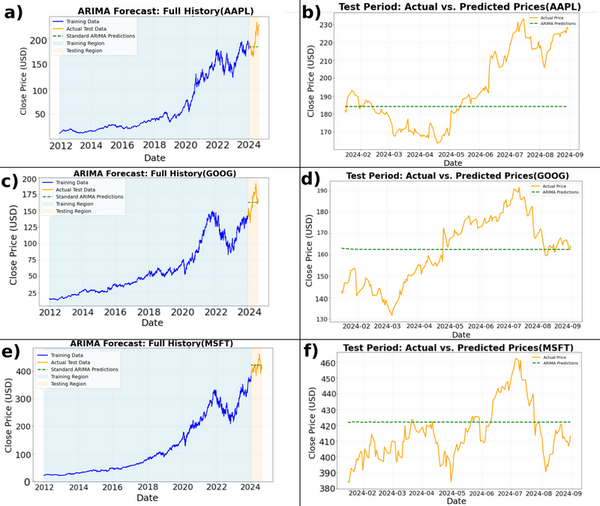
Classical financial econometric models often fail to capture the complex, nonlinear dynamics of stock price movements. This study addresses this limitation by investigating the predictive power of a financial time series' underlying geometric structure. We hypothesized that incorporating a geometric curvature metric—an exogenous variable derived from hyperbolic geometry to model hierarchical patterns—would significantly improve the forecasting accuracy of a standard econometric model. To test this hypothesis, we measured the effect of introducing this single variable into an autoregressive integrated moving average (ARIMA) model using daily stock data for Apple, Google, and Microsoft. The inclusion of the geometric curvature variable led to a substantial reduction in forecasting error, with root mean square errors (RMSEs) decreasing from 6.64 to 2.88 for Apple, 13.65 to 2.50 for Google, and 23.51 to 5.26 for Microsoft. This demonstrates that geometric curvature is a significant predictive factor in time-series analysis and suggests that incorporating geometric properties offers a powerful method for enhancing econometric forecasts, with broad implications for risk management.
This article has been tagged with: