The effectiveness of glass fines on the fire resistance of mycelium-based biocomposites
(1) Saint Joseph’s Institution International, (2) Biology, Saint Joseph’s Institution International
https://doi.org/10.59720/25-245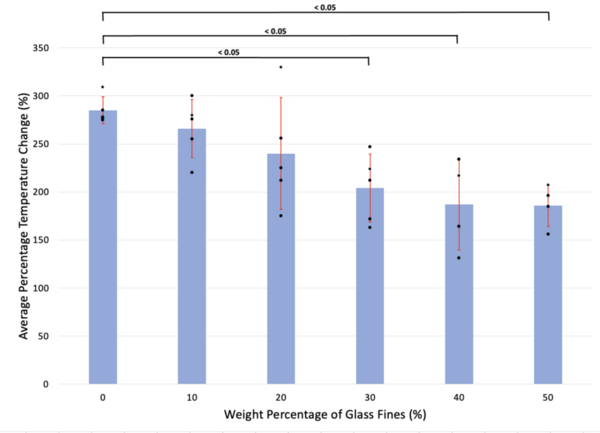
Mycelium-based biocomposites are emerging as a more sustainable alternative to plastic. Hence, they are widely applied in different industrial sectors such as construction, packaging, and manufacturing. Mycelium, the segment of the mushroom containing vegetative fungal threads, acts as a natural adhesive that binds substrate containing waste material, creating a mycelium biocomposite. The alteration of the material within the substrate can modify the properties of the mycelium biocomposite produced. In this experiment, the effects of different weight percentages (0-50wt%) of silica glass fines, small glass particles between 3mm and 8mm in size, on the fire resistance of Pleurotus ostreatus mycelium biocomposites were evaluated. The glass fines are rich in silica, enhancing the fire resistance of the composite through forming char and silica ash during heating. Fire reaction properties were tested using a Bunsen burner flame with surface temperature changes measured as a proxy for fire resistance. We hypothesized that when the wt% of glass fines in the substrate is increased, there will be a corresponding increase in fire resistance. The results indicated a significant reduction in surface temperature change at 30wt% and greater, which is attributed to improved thermal stability and silica ash formation. One-way ANOVA and Tukey-Kramer tests further confirmed that increasing the wt% of glass fines significantly enhanced fire resistance. These findings shed light on the potential of mycelium-based biocomposites as renewable materials for semi-structural applications in environments that require resistance to elevated temperatures.
This article has been tagged with: