Optimizing website performance: A comprehensive Google Lighthouse study on desktop and mobile modes
(1) Al-Wealy Secondary School for Distinguished Boys, (2) Babylon Sewerage Department
https://doi.org/10.59720/25-267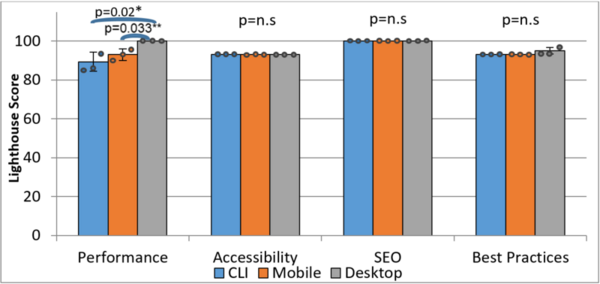
Website technical performance is a major factor for user satisfaction and experience, especially in areas where the internet is slow or the operating device has limited capabilities. Therefore, Google LLC developed the Lighthouse tool to improve website performance; it measures five audit categories: Performance, Accessibility, Search Engine Optimization (SEO), Best Practices, and Progressive Web App (PWA). However, the consistency and reliability of its results, particularly via the Command Line Interface (CLI), have not been thoroughly explored. Therefore, this study aimed to investigate the reliability (stability across repeated runs) and consistency (agreement of scores across different tools (CLI vs DevTools) and modes (desktop vs mobile) of Lighthouse results. We hypothesized the Performance scores would vary significantly depending on the mode and website complexity, unlike Accessibility, SEO, and Best Practices scores. We ran Lighthouse on a real website (Detective) using both CLI and Chrome DevTools under desktop and mobile modes 3 times. To provide a point for comparison, we ran two additional sites: Wikipedia and the New York Times using DevTools one time. Performance scores significantly fluctuated: CLI runs on the Detective site ranged from 86 to 95, and DevTools tests revealed values between 21 and 100 across various modes and sites, while Accessibility, SEO, and Best Practices scores remained consistent (≥90). These findings suggest that developers may need to repeat tests for more stable outputs. This paper highlights the features and limitations of Lighthouse as an auditing tool and offers insights into best-use practices for web developers.
This article has been tagged with: