Canopy complexity and plant morphology determine detectability in multi-perspective drone imagery
(1) Monta Vista High School, (2) Brown University
https://doi.org/10.59720/25-277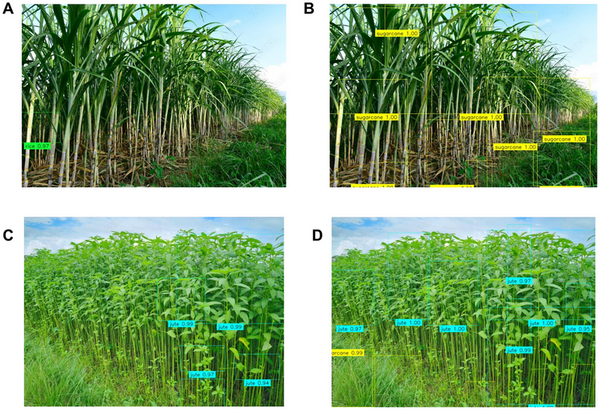
Accurate identification of plant species in drone imagery is important for vegetation monitoring, but plant morphology, including branching, leaf orientation, and vertical layering, influences how reliably deep-learning models can detect and classify plants in these images. Canopy complexity, in particular, can obscure diagnostic features, making some species more challenging to identify than others. Single-perspective surveys often miss plants that are partially hidden beneath dense or layered canopies. In this study, we evaluated whether multi-perspective drone imagery improves classification accuracy compared to aerial-only surveys by testing the role of the canopy structure of crops. We hypothesized that species with more complex canopies would show greater improvements in classification accuracy when analyzed with multi-perspective drone imagery. We analyzed approximately 1,250 images from five agricultural crop species that span a gradient of morphological complexity using a deep learning pipeline that combined RetinaNet and ResNet-50 models. We found that overall classification accuracy increased from 35.73% with aerial imagery to 52.93% with multi-perspective imagery. Species with structurally complex canopies showed the largest gains in accuracy, whereas low-complexity crops exhibited only marginal improvement. By linking plant morphology to model performance, our study shows that multi-perspective drone surveys are especially valuable for identifying species with complex canopies. These findings can guide field operators in designing effective drone-based monitoring strategies, particularly for invasive plant species with dense or multilayered canopies that are often missed in traditional aerial surveys.
This article has been tagged with: