Integrated expression, mutation, and survival analysis of 17 key genes in breast cancer using TCGA-BRCA data
(1) Richard Montgomery County High School, (2) Montgomery Blair High School
https://doi.org/10.59720/25-295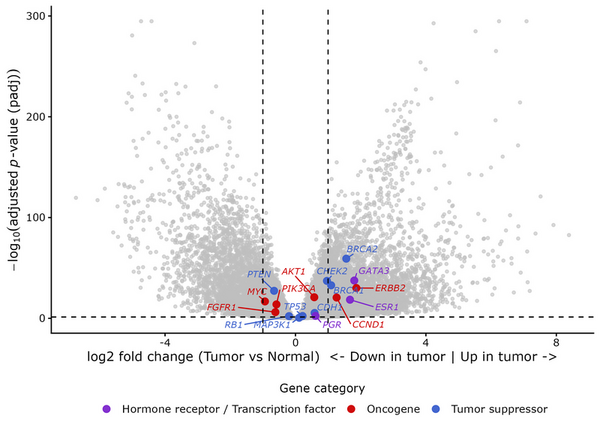
Breast cancer is the most common type of cancer in women around the world, and some forms of breast cancer have a strong genetic component. We examined 17 clinically significant genes to assess their potential impact on breast cancer. These included oncogenes (such as ERBB2 and CCND1), tumor suppressors (such as TP53 and BRCA1/2), and hormone receptors (such as ESR1 and PGR). We analyzed gene expression, mutation status, and patient survival using data from the TCGA-BRCA cohort. We hypothesized that breast tumors would exhibit transcriptional dysregulation and mutations in key genes such as BRCA1, BRCA2, and TP53, and that these molecular changes would be associated with differences in patient survival. We conducted differential expression analysis, heatmap clustering, survival modeling, and mutation analysis. Our results demonstrated substantial transcriptional differences between tumor and normal tissues. The upregulation of ERBB2, ESR1, and CCND1 in malignancies exemplified this phenomenon. Notably, MYC and RB1 showed reduced mRNA expression, while tumor suppressors BRCA2 and CHEK2 were increased. Survival analysis suggested possible associations between increased expression of TP53, BRCA1, and BRCA2 with patient outcomes; however, these findings were not statistically significant. Mutation analysis identified TP53 as the most frequently mutated gene, whereas mutations in BRCA1 and BRCA2 were infrequent and not associated with significant changes in transcript abundance. Overall, our findings highlight the complexity of breast cancer biology and emphasize the value of integrated genomic analyses for understanding disease mechanisms and therapeutic implications.
This article has been tagged with: