Exploring chemical cue perception in gordiid worms: A behavioral assessment
(1) Carl-Zeiss-Gymnasium, (2) Institute for Zoology and Evolutionary Research, Friedrich-Schiller-University Jena
* These authors made equal contributions
https://doi.org/10.59720/25-308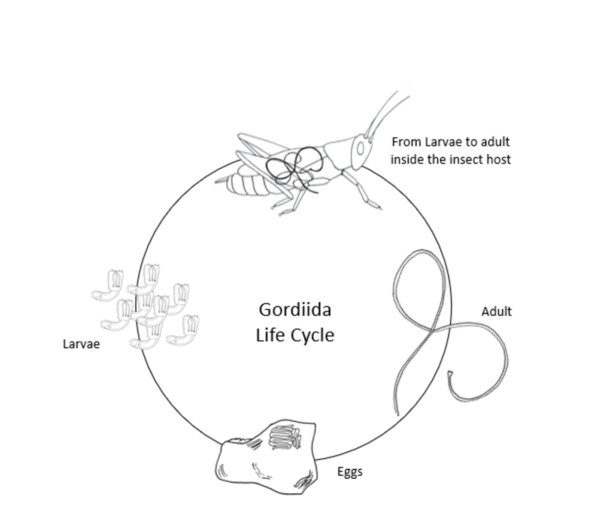
Nematomorph parasites, or horsehair worms, are probably best known for their ability to force their final insect hosts to enter water, where the worms emerge to complete their life cycle. To date, not much is known about these fascinating organisms and huge knowledge gaps remain about large parts of the nematomorph life history. With this project, we wanted to address questions regarding nematomorph behavior outside the final host and investigate whether adult behavior is influenced by chemical cues in the environment. We hypothesized that freshwater nematomorphs use chemical cues for both mate finding and predator avoidance. To test this, we exposed nematomorphs to a) water exposed to worms of the opposite sex (mate finding), b) water that contained ground nematomorphs to simulate the presence of injured or dead animals (predator avoidance), and c) plain freshwater (negative control). Although we did not detect any significant effects of the tested cues, our findings highlight both the challenges of studying nematomorphs and the potential of chemical ecology as a promising avenue for future research. By establishing a foundation for examining nematomorph responses to environmental stimuli, this work underscores the need for continued efforts to uncover the sensory and behavioral mechanisms that shape the ecology of these unique parasites.
This article has been tagged with: