Anticonvulsant effects of non-pharmaceutical treatments in bang-sensitive D. melanogaster mutants
(1) Brooklyn Technical High School
https://doi.org/10.59720/25-323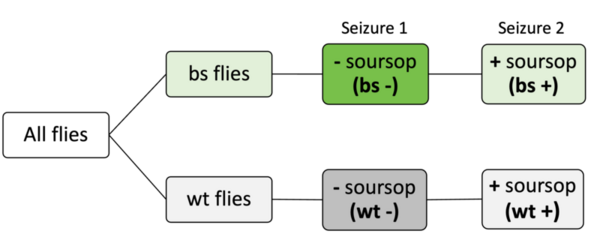
Epilepsy impacts 50 million people worldwide, and approximately 30% of people with epilepsy are unresponsive to treatments. Antiepileptic medications (AEDs) can be costly and may cause harmful side-effects, calling for the development of novel, non-pharmaceutical treatments. We conducted this study to determine whether non-pharmaceutical treatments, including Annona muricata (soursop), β-hydroxybutyrate (BHB; representing the ketogenic diet (KD)), and circadian synchronization, are effective in reducing duration of seizure-like behavior in bang-sensitive (bs) Drosophila melanogaster mutants, an established model for epilepsy research, and whether circadian synchronization can improve the effectiveness of KD. We hypothesized that non-pharmaceutical treatments, including soursop, KD, and circadian synchronization, either alone or in combination, would decrease recovery time in bs D. melanogaster mutants. For soursop treatment, recovery time was measured before D. melanogaster mutants were given vortex-induced seizure and measured again after treatment with soursop. For BHB treatment, recovery times of flies given BHB prior to vortex-induced seizure were compared with those of untreated flies. The effect of circadian synchronization (via entrainment to light-dark cycles) was measured alone, as well as in combination with BHB. We observed that treatment with soursop resulted in longer recovery times when compared with no treatment. Non-pharmaceutical interventions such as KD and circadian synchronization both reduced seizure duration in bs D. melanogaster. However, the interaction between BHB and circadian synchronization was not statistically significant. Further exploration of the interaction between circadian synchronization and medication effectiveness in fly models and humans is necessary for the development of safe, accessible treatments for epilepsy in humans.
This article has been tagged with: