Geographic proximity to strong competitors and team performance in high school water polo
(1) Troy High School, (2) Department of Marketing, Penn State University
https://doi.org/10.59720/26-046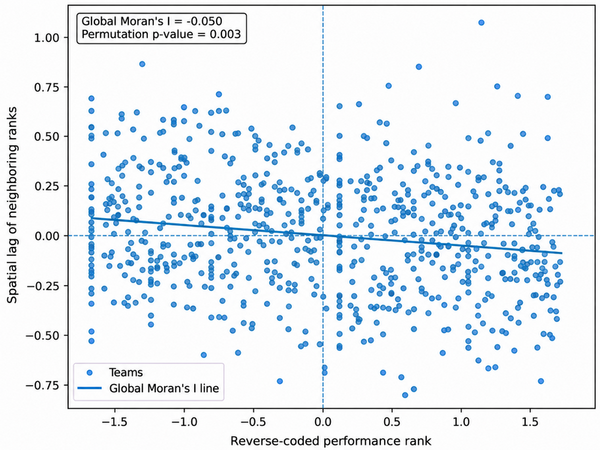
Geographic proximity may influence competitive outcomes in youth sports because nearby teams often compete within shared regional environments and may encounter many of the same opponents. However, the spatial aspect of team performance has rarely been quantitatively examined. In this study, we investigated whether season-record performance in high school water polo exhibited spatial clustering across teams. We hypothesized that teams located near high-performing high school water polo programs would demonstrate similar performance outcomes, resulting in positive spatial autocorrelation. We collected publicly available team performance data for the 2024-2025 season from U.S. high school boys’ water polo teams at the national level and within California. We analyzed these data alongside geographic location information and applied Moran’s I, a spatial autocorrelation statistic that measures whether nearby teams tend to have more similar or more dissimilar performance outcomes than expected by chance. Contrary to our hypothesis, we found no evidence of positive spatial clustering in team performance. Instead, the results revealed weak but statistically significant spatial dispersion at both the national level and within California, a region with high team density and competitive intensity. Overall, the 2024–2025 season showed that proximity to strong high school water polo programs did not correspond to localized clusters of similar team performance. Our study highlights the importance of empirically testing intuitive assumptions about competitive environments and demonstrates how spatial statistical methods can be applied to evaluate performance structure in youth sports.
This article has been tagged with: