Browse Articles

Deep learning for pulsar detection: Investigating hyperparameter effects on TensorFlow classification accuracy

Upadhyay et al. | Jan 31, 2026

Deep learning for pulsar detection: Investigating hyperparameter effects on TensorFlow classification accuracy

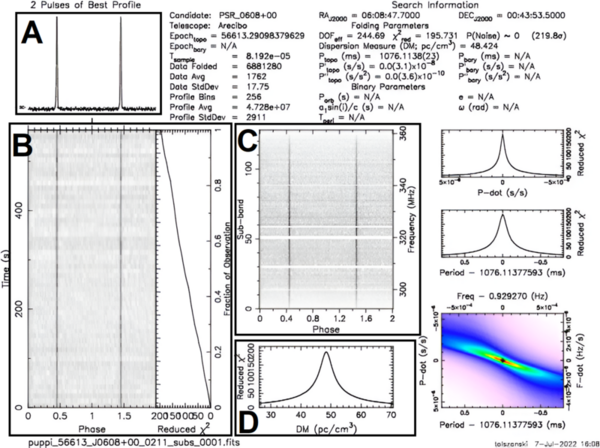
This study investigates how the hyperparameters epochs and batch size affect the classification accuracy of a convolutional neural network (CNN) trained on pulsar candidate data. Our results reveal that accuracy improves with increasing number of epochs and smaller batch sizes, suggesting that with optimized hyperparameters, high accuracy may be achievable with minimal training. These findings offer insights that could help create more efficient machine learning classification models for pulsar signal detection, with the potential of accelerating pulsar discovery and advancing astrophysical research.

Read More...


Prediction of preclinical Aβ deposit in Alzheimer’s disease mice using EEG and machine learning

Igarashi et al. | Nov 29, 2022

Prediction of preclinical Aβ deposit in Alzheimer’s disease mice using EEG and machine learning

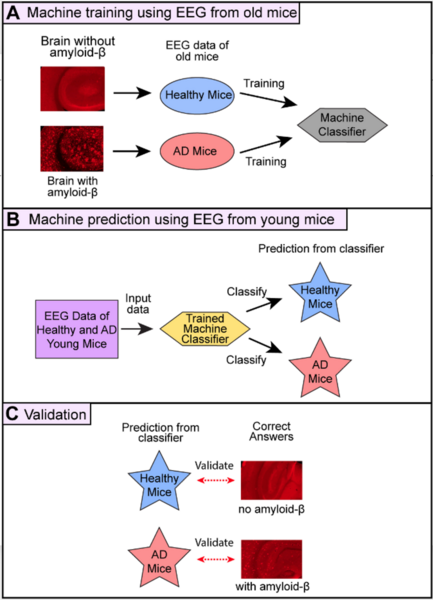
Alzheimer’s disease (AD) is a common disease affecting 6 million people in the U.S., but no cure exists. To create therapy for AD, it is critical to detect amyloid-β protein in the brain at the early stage of AD because the accumulation of amyloid-β over 20 years is believed to cause memory impairment. However, it is difficult to examine amyloid-β in patients’ brains. In this study, we hypothesized that we could accurately predict the presence of amyloid-β using EEG data and machine learning.

Read More...

Indoor near-field target detection characteristics under radio and radar joint operation at 2.4 GHz ISM band

Koh et al. | Apr 29, 2022

Indoor near-field target detection characteristics under radio and radar joint operation at 2.4 GHz ISM band

In our modern age, the burgeoning use of radios and radars has resulted in competition for electromagnetic spectrum resources. With recent research highlighting solutions to radio and radar mutual interference, there is a desperate need for a cost-effective configuration that permits a radar-radio joint system. In this study, the authors have set out to determine the feasibility of using single-tone continuous-wave radars in a radar-joint system. With this system, they aim to facilitate cost-effective near-field target detection by way of the popularized 2.4-GHz industrial, scientific, and medical (ISM) band.

Read More...