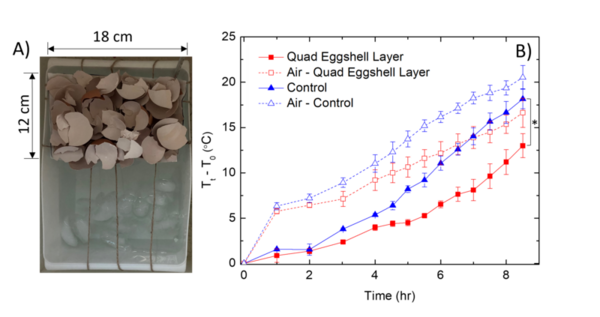
The authors looked at the ability of eggshells to slow ice melting. They found that eggshells were able to increase ice melting time when crushed showing that they were an effective thermal barrier.
Read More...Slowing ice melting from thermal radiation using sustainable, eco-friendly eggshells
The authors looked at the ability of eggshells to slow ice melting. They found that eggshells were able to increase ice melting time when crushed showing that they were an effective thermal barrier.
Read More...Scientific project in physics "Carbonated liquids and carbonation level"
In our work we followed the formation of gas bubbles on the surface of the vessel walls in different carbonated liquids, over different time intervals, at different temperatures and in vessels made of different materials. Our results made it possible to identify patterns affecting the process of formation and disappearance of carbon dioxide bubbles.
Read More...Suppress that algae: Mitigating the effects of harmful algal blooms through preemptive detection & suppression
A bottleneck in deleting algal blooms is that current data section is manual and is reactionary to an existing algal bloom. These authors made a custom-designed Seek and Destroy Algal Mitigation System (SDAMS) that detects harmful algal blooms at earlier time points with astonishing accuracy, and can instantaneously suppress the pre-bloom algal population.
Read More...Transfer learning and data augmentation in osteosarcoma cancer detection
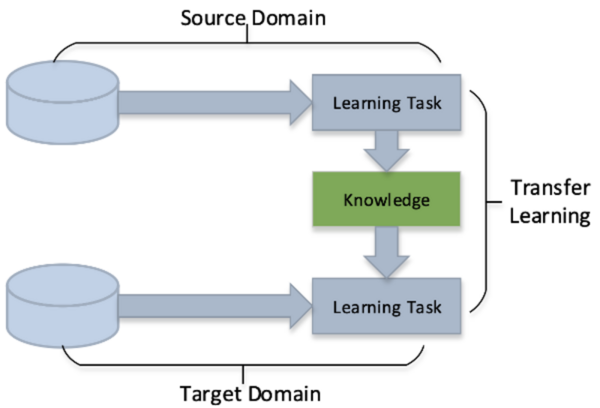
Osteosarcoma is a type of bone cancer that affects young adults and children. Early diagnosis of osteosarcoma is crucial to successful treatment. The current methods of diagnosis, which include imaging tests and biopsy, are time consuming and prone to human error. Hence, we used deep learning to extract patterns and detect osteosarcoma from histological images. We hypothesized that the combination of two different technologies (transfer learning and data augmentation) would improve the efficacy of osteosarcoma detection in histological images. The dataset used for the study consisted of histological images for osteosarcoma and was quite imbalanced as it contained very few images with tumors. Since transfer learning uses existing knowledge for the purpose of classification and detection, we hypothesized it would be proficient on such an imbalanced dataset. To further improve our learning, we used data augmentation to include variations in the dataset. We further evaluated the efficacy of different convolutional neural network models on this task. We obtained an accuracy of 91.18% using the transfer learning model MobileNetV2 as the base model with various geometric transformations, outperforming the state-of-the-art convolutional neural network based approach.
Read More...A comparative analysis of synthetic and natural fabrics
The authors test the durability of synthetic versus non-synthetic fabrics though loose thread counts, color fade over time, and shrinkage tests.
Read More...Prediction of molecular energy using Coulomb matrix and Graph Neural Network
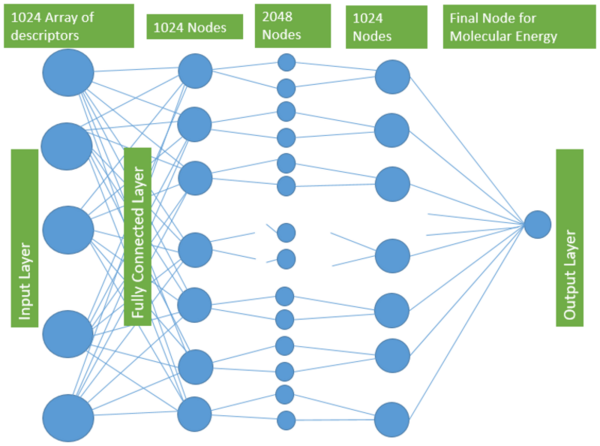
With molecular energy being an integral element to the study of molecules and molecular interactions, computational methods to determine molecular energy are used for the preservation of time and resources. However, these computational methods have high demand for computer resources, limiting their widespread feasibility. The authors of this study employed machine learning to address this disadvantage, utilizing neural networks trained on different representations of molecules to predict molecular properties without the requirement of computationally-intensive processing. In their findings, the authors determined the Feedforward Neural Network, trained by two separate models, as capable of predicting molecular energy with limited prediction error.
Read More...The effects of container materials on food microwave heat times
The authors analyzed the heat transfer of different containers in the microwave aiming to identify the most optimal material of container to reduce heating time.
Read More...Exploring Unconventional Growing Methods to Promote Healthy Growth in Common Household Plants: Tagetes patula L. and Lepidium sativum
This study focused on finding more sustainable growing methods that reduce chemical fertilizer or water usage and can be used at the household level for garden plants. Metrics for healthy plant growth were height at first bloom, growing time, and survival rate. The Deep Water Culture (DWC) treatment for garden cress plants significantly increased the height at first bloom compared to the control group. For rates of surviving plants, the treatments had little effect on garden cress, but the Eggshell Grounds, Wick System, and DWC system groups outperformed the control group for marigolds.
Read More...Population Forecasting by Population Growth Models based on MATLAB Simulation
In this work, the authors investigate the accuracy with which two different population growth models can predict population growth over time. They apply the Malthusian law or Logistic law to US population from 1951 until 2019. To assess how closely the growth model fits actual population data, a least-squared curve fit was applied and revealed that the Logistic law of population growth resulted in smaller sum of squared residuals. These findings are important for ensuring optimal population growth models are implemented to data as population forecasting affects a country's economic and social structure.
Read More...Antibacterial Effects of Copper Surfaces
This study examined the ability of copper and copper alloy surfaces to inhibit bacterial growth, which may be help prevent healthcare-associated infections. The authors exposed two non-pathogenic strains of bacteria to different metal plates for varying degrees of time and measured bacterial growth.
Read More...