Browse Articles

Evaluating the impact of prompting styles on LLM accuracy for AIME math questions

Ganesa et al. | Jul 26, 2026

Evaluating the impact of prompting styles on LLM accuracy for AIME math questions

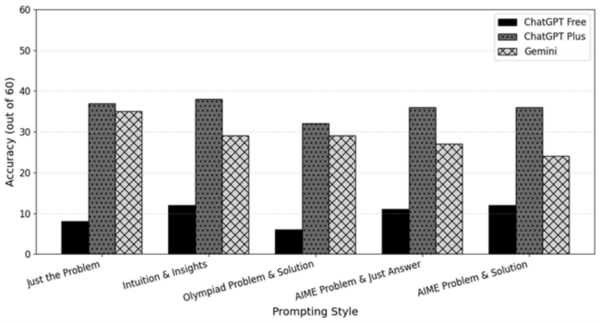
Large language models are increasingly used to solve math problems, but their ability to handle multi-step reasoning remains uncertain. In this study, students tested whether different prompting styles could improve LLM accuracy on challenging AIME math questions and found that detailed step-by-step solutions did not significantly outperform simpler prompts. These results suggest that improving LLM mathematical reasoning may require deeper model-level advances rather than changes in prompting style alone.

Read More...


Validating DTAPs with large language models: A novel approach to drug repurposing

Curtis et al. | Mar 02, 2025

Validating DTAPs with large language models: A novel approach to drug repurposing
Image credit: Growtika

Here, the authors investigated the integration of large language models (LLMs) with drug target affinity predictors (DTAPs) to improve drug repurposing, demonstrating a significant increase in prediction accuracy, particularly with GPT-4, for psychotropic drugs and the sigma-1 receptor. This novel approach offers to potentially accelerate and reduce the cost of drug discovery by efficiently identifying new therapeutic uses for existing drugs.

Read More...

Large Language Models are Good Translators

Zeng et al. | Oct 16, 2024

Large Language Models are Good Translators

Machine translation remains a challenging area in artificial intelligence, with neural machine translation (NMT) making significant strides over the past decade but still facing hurdles, particularly in translation quality due to the reliance on expensive bilingual training data. This study explores whether large language models (LLMs), like GPT-4, can be effectively adapted for translation tasks and outperform traditional NMT systems.

Read More...