Measuring effects of caffeine and melatonin on learning trends of Zebrafish juveniles
(1) Cox Mill High School, (2) Department of Earth, Environmental, and Geographical Sciences, Center for Applied Geographic Information Science | School of Data Science, University of North Carolina Charlotte, (3) Department of Computer Science, University of North Carolina Charlotte
https://doi.org/10.59720/25-122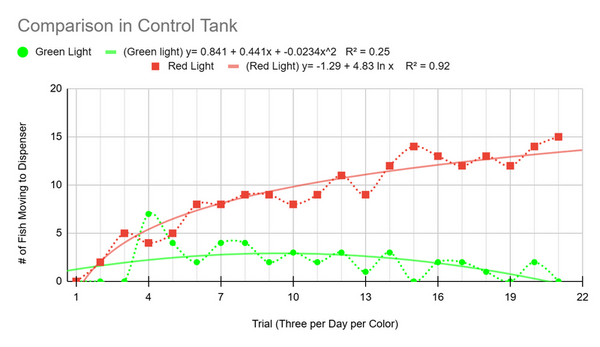
As humans navigate a renewed digital age, the use of energy-influencing substances like caffeine and melatonin has risen, especially among adolescents. Many teens consume energy drinks with high caffeine levels and take melatonin to sleep. The effects of these substances on the adolescent brain and learning are not well understood. This study used juvenile zebrafish (Danio rerio) to examine how caffeine and melatonin affect learning. We randomly assigned zebrafish to three groups: caffeine-treated, melatonin-treated, and control. To minimize the external stressors caused by human intervention, we developed an automated learning and video-recording system. Over one week, we observed notable differences in learned responses between the groups. We hypothesized that melatonin would increase the amount of time it took for the zebrafish to learn food-associated visual cues, while caffeine would cause more variation in learning time. We found that caffeine led to erratic, fluctuating behaviors, while melatonin slowed learning. Both made learning inconsistent, with caffeine causing more extreme effects. Our results indicate that melatonin and caffeine negatively impact learning trends among zebrafish adolescents in a statistically significant manner, potentially suggesting a similar effect on human adolescents’ learning patterns. Further investigation is needed to delve into the physiological effects of these compounds and the mechanisms by which they influence learning patterns, as well as whether these compounds have similar effects in adolescent humans.
This article has been tagged with: