B cell dynamics as predictive markers in triple-negative breast cancer treated with Pembrolizumab & radiation
(1) Mission San Jose High School
https://doi.org/10.59720/25-206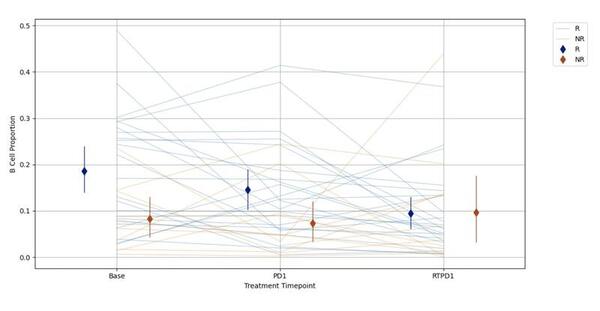
By combining precise tumor targeting with immune system activation, radiation and immunotherapy have emerged as powerful approaches to extend cancer patient survival and enhance quality of life. While much of this progress has focused on T cell-mediated responses, our study focuses on the role of B cells in predicting response to combined pembrolizumab and radiation therapy in triple-negative breast cancer. We investigated how the combination of pembrolizumab, a programmed cell death 1 (PD-1) immune checkpoint inhibitor, and radiation therapy modulates immune cell dynamics in triple negative breast cancer patients who are responders versus non-responders. We hypothesized that responders would exhibit higher B cell proportions than non-responders throughout treatment, and that longitudinal changes in B cell abundance following PD-1 and radiation plus PD-1 (RT+PD-1) therapy would distinguish patients who benefit from combination therapy. We analyzed single cell RNA sequencing data from a publicly available 50-patient cohort that details a trial on RT+PD-1 therapy. Notably, our findings demonstrated that B cell proportions were higher in responders than non-responders at baseline and after PD-1 therapy, without evidence of a consistent within-responder increase. After RT+PD-1 therapy, this between-group difference was no longer significant. Non-responders exhibited consistently low B cell proportions at the onset and throughout their course of treatment. These results demonstrate a predictive role for B cells in PD-1 and RT+PD-1 therapy and their value as a biomarker for screening patients that could benefit from the combined therapy.
This article has been tagged with: