Browse Articles

Idotea balthica comparison: Anatomy, locomotion, and seaweed preference of Massachusetts isopods

Yee et al. | Feb 17, 2022

<em>Idotea balthica</em> comparison: Anatomy, locomotion, and seaweed preference of Massachusetts isopods

Here the authors examined a population of Massachusetts marine isopods, seeking to classify them based on comparison of their morphology, movement, and seaweed preference compared to those of known species. In this process they found that they were most similar to Idotea balthica. The authors suggest that this knowledge combined with monitoring populations of marine biology such as these isopods in different physical and ecological areas can provide useful insight into the effects of climate change.

Read More...

Increasing Average Yearly Temperature in Two U.S. Cities Shows Evidence for Climate Change

Savage et al. | Sep 20, 2018

Increasing Average Yearly Temperature in Two U.S. Cities Shows Evidence for Climate Change

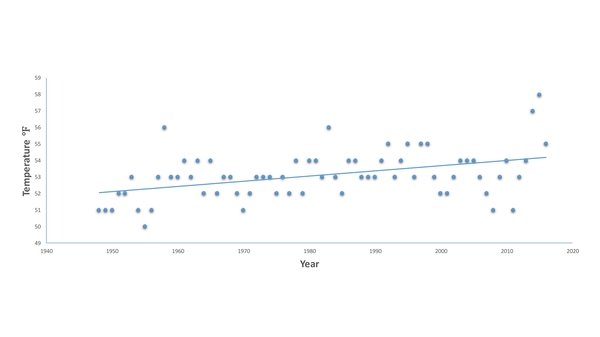
The authors were interested in whether they could observe the effects of climate change by analyzing historical temperature data of two U.S. cities. They predicted that they should observe a warming trend in both cities. Their results showed that despite yearly variations, warming trends can be observed both in Rochester, NY and Seattle, WA which fit the predictions of climate change forecasts.

Read More...

The ecological mysteries of Opheodesoma spectabilis : Seasonal trends, habitat preferences, and climate responses

Watson et al. | Jul 26, 2026

The ecological mysteries of <i>Opheodesoma spectabilis</i>	: Seasonal trends, habitat preferences, and climate responses

This study examines how environmental conditions influence the abundance and ecological role of the sea cucumber Opheodesoma spectabilis in Kāneʻohe Bay. Field observations and laboratory experiments showed that the species is more common in algae-dominated sandy habitats, where it improves water clarity and increases dissolved oxygen through bioturbation. However, exposure to very high temperatures caused rapid mortality, suggesting that marine heat waves could threaten this species and the ecological functions it provides.

Read More...

Forecasting air quality index: A statistical machine learning and deep learning approach

Pasula et al. | Feb 17, 2025

Forecasting air quality index: A statistical machine learning and deep learning approach
Image credit: Amir Hosseini

Here the authors investigated air quality forecasting in India, comparing traditional time series models like SARIMA with deep learning models like LSTM. The research found that SARIMA models, which capture seasonal variations, outperform LSTM models in predicting Air Quality Index (AQI) levels across multiple Indian cities, supporting the hypothesis that simpler models can be more effective for this specific task.

Read More...